





[2026-10-22] ÖGNI Symposium with Ban Ki-moon Puts Sustainable Transformation in the Spotlight
ÖGNI Symposium with Ban Ki-moon Highlights Sustainable Transformation
The former UN Secretary-General spoke about climate protection, international cooperation, and social responsibility. Other key topics included the challenges facing the real estate industry and practical solutions developed by three working groups.
On October 22, 2026, the Austrian Sustainable Building Council (ÖGNI) held its Sustainability Symposium for the second time. Experts from Germany, Austria, and Switzerland had previously examined various challenges related to sustainable development and developed practical solutions to address them. The discussions focused, among other topics, on the circular economy, digital technologies, and the importance of cities and municipalities in driving environmental and social transformation. The results were presented at the event in Vienna.
Ban Ki-moon Calls for Shared Responsibility
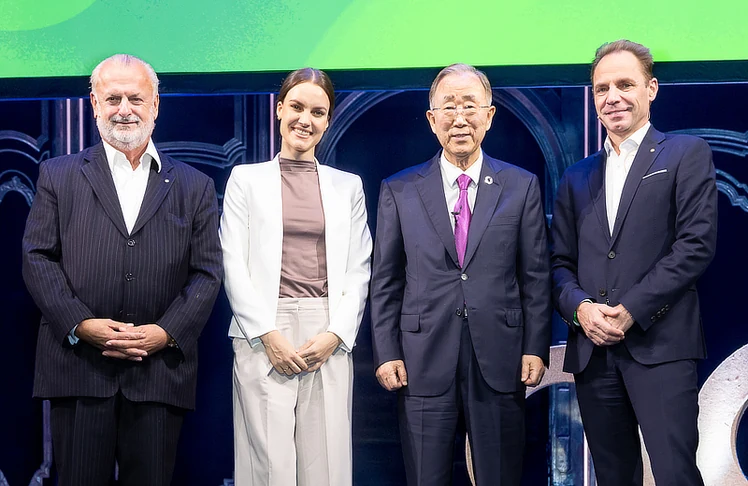
Former UN Secretary-General Ban Ki-moon was among the prominent guests at the symposium. In a conversation with moderator Manuela Raidl, he discussed international challenges, the importance of the United Nations, and the role of education in processes of social change. Climate protection was also a central topic of the discussion.
Ban Ki-moon reflected on his previous work as head of the United Nations. During his tenure, he had worked to promote peaceful relations between countries and to enable people to live in safety and peace. He said that the invitation to the symposium demonstrated that the organizers also supported these goals.
“I therefore hope that this evening will provide an opportunity to seriously reflect on how we can all contribute to peace, security, sustainable development, human rights, and the eradication of poverty – not only as political or business leaders, but also as private individuals,” Ban Ki-moon stated.
The former UN Secretary-General thus emphasized that addressing global challenges requires collective efforts and that responsibility should not rest exclusively with political and economic decision-makers.
Climate Protection Requires Structural Change
Climate journalist Louisa Schneider addressed another major theme in her keynote presentation. She discussed the impacts of the climate crisis and the conditions necessary for effective countermeasures.
She made it clear that responsibility for climate protection should not primarily be placed on individual citizens. Instead, governments and businesses must establish the appropriate frameworks.
“Climate protection is clearly a systemic issue – we must no longer shift responsibility onto individuals and citizens’ personal sense of responsibility,” Schneider said.
In her view, political and economic structures are needed to make sustainable behavior the norm. The willingness of key stakeholders to drive fundamental changes is essential. Only in this way can sustainability goals be translated into concrete and measurable progress.
Three Working Groups Develop Practical Solutions
In addition to presentations and discussions, the program featured the findings of three working groups. Under the event’s theme, “Sustainability: Turning Intentions into Impact!”, the groups explored various issues related to technological and social transformation.
Their areas of focus included “Targeted Digitalization Through Transparent Data Flows,” “Artificial Intelligence and Robotics from a Socio-Political Perspective,” and “Lifelong Learning as a Key to Transformation.”
One proposal from the working group on “Artificial Intelligence and Robotics from a Socio-Political Perspective” concerned the taxation of human and automated labor. The group recommended completely abolishing employer-paid payroll contributions and compensating for the resulting loss of revenue through higher taxes on corporate profits.
The proposal was based on the argument that employing human workers entails additional costs through payroll-related contributions, whereas the use of artificial intelligence and robotic systems does not incur comparable financial burdens. This disparity could encourage companies to shift tasks toward automated processes and, in the long term, make it more difficult to finance public services. Through its proposal, the working group sought to reduce the financial burden on human labor while ensuring that profits generated through automation contribute more substantially to public funding.
ÖGNI Managing Director Advocates a Holistic Approach
Peter Engert, Managing Director of ÖGNI, also addressed the conditions necessary for the long-term sustainable development of the real estate industry. He argued that different influencing factors should no longer be considered separately.
“The time for isolated debates is over. Anyone who wants sustainable real estate must consider, assess, and implement existing building stock, operations, financing, technology, and social acceptance together,” Engert emphasized.
In his view, sustainable real estate planning and implementation must therefore take into account existing buildings and their ongoing operations, as well as economic conditions, technological developments, and societal requirements.