






[2026-05-06] Stanford forum examines sustainability solutions
Researchers presented new methods for tracking wildfire pollution and recovering bleached corals while former government officials and leaders from business and civil society called for urgent responses to food security, climate risks, and AI energy demand.
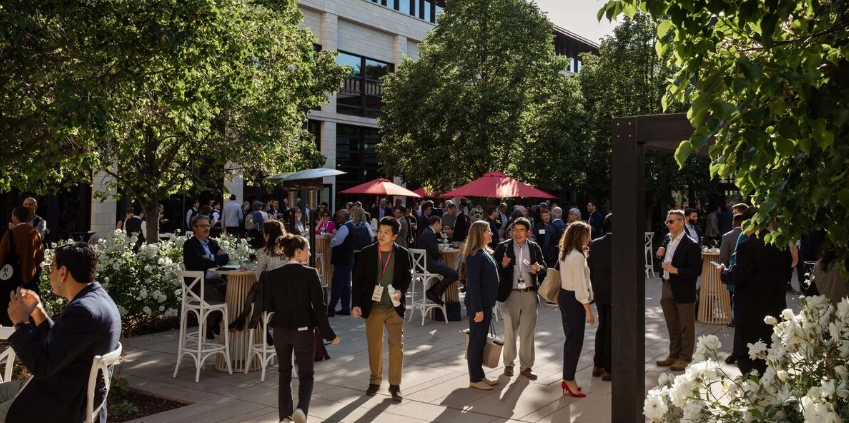
Across two days of panels and presentations, participants in the Stanford Sustainability Forum examined how solutions to planetary challenges can move from laboratories and pilot projects into widespread use. (Image credit: Patrick Beaudouin)
New sensors may help us anticipate and avoid breathing waves of dangerous toxic metals in wildfire smoke. Advanced machine learning models may make it easier to prepare for power outages caused by extreme weather. Bleached corals may be able to recover with help from healthy neighbors.
These were among the promising discoveries and ideas presented at the Stanford Sustainability Forum last month. Hosted by the Stanford Doerr School of Sustainability, the event convened more than 480 researchers, entrepreneurs, executives, and civil society leaders from dozens of states and 13 countries to examine how research can translate to solutions and what obstacles stand in the way.
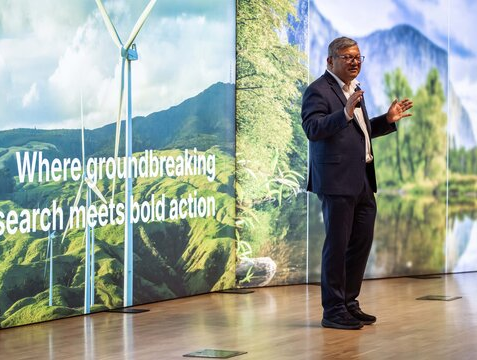
“Cleaner must be cheaper. That’s the only way to scale,” said Arun Majumdar, the Chester Naramore Dean of the Stanford Doerr School of Sustainability, during a keynote address at the Stanford Sustainability Forum on April 29, 2026. (Image credit: Patrick Beaudouin)
“We created the Doerr School of Sustainability with a vision both simple and audacious: to serve life on Earth,” Arun Majumdar, the school’s dean, said after the event. “The Forum is the living expression of our school’s mission to bring together people and ideas ready for bold action.”
Food security as national security
Chef José Andrés, founder of the food-relief nonprofit World Central Kitchen, stressed that effective disaster response and recovery involve listening to local residents and recognizing resources on the ground – from restaurants and bakeries that can be converted to emergency kitchens, to fishers and boat owners who can help supply and deliver food. “You cannot bring everybody from the outside. You need to rely on the power of the local community,” he said.
He also warned that Florida’s near-total loss of orange production signals risks to staple crops. “I’m fascinated that this is not at the highest level of national security in the country,” Andrés said. “What happens if we have a big drought at the same time equally in the food production areas?” He warned of the risk of mass starvation and urged governments, starting with the United States, to have a “national security food advisor very close to the ear of the president.”
Key to the solution, he said, is simplifying the core mission of agencies tasked with providing emergency food aid to “feed everybody and as quick as we can, bring water to everybody as quick as we can, and do whatever it takes to do it today.”
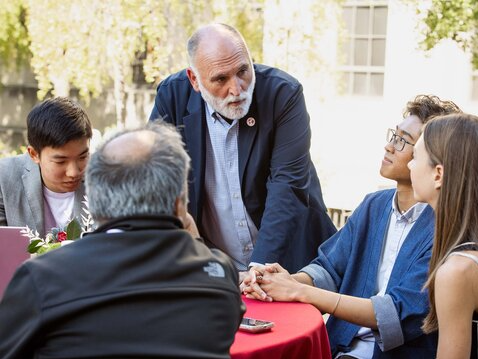
Chef and restaurateur José Andrés, founder of the food-relief organization World Central Kitchen, spoke with students at the Stanford Sustainability Forum. (Image credit: Patrick Beaudouin)
Building ‘herd immunity’ against fire
California’s rainy season now arrives about 30 days later than it did decades ago, leaving vegetation tinder dry when late fall winds peak, said Ann Patterson, a policy scholar at Stanford who previously advised the governor on wildfires and insurance issues. “That’s a recipe for wildfire disaster,” she said.
The number of extreme fire weather days in California has doubled since the early 1980s and is expected to grow with continued warming, she added. Even homes hardened against fires are at risk of burning if surrounded by neighbors with wooden roofs and fences. “You have to have kind of herd immunity,” Patterson said. Policies and regulations can help drive the necessary coordination.
Alongside the pursuit of policy and technological solutions, Stanford Climate and Energy Policy Program director Michael Wara said it’s important to understand the context for climate impacts. “The impacts that people feel are very contextual, and they depend on both the vulnerabilities that were there to start with that are maybe becoming more extreme, more frequent due to the changing climate, but also the societal context in which risk and hazard exist,” he said.
‘We must mobilize all’
Former UN Secretary-General Ban Ki-moon called for sustained partnerships among governments, businesses, and civil society to limit climate change and mitigate its impact, referencing the goal of keeping global temperatures below 1.5 degrees Celsius above pre-industrial levels.
“We just began talking about the 1.5 degree limit. It’s now almost impossible if we go in this speed. Therefore, we must mobilize all,” he said in a panel discussion moderated by 66th U.S. Secretary of State Condoleezza Rice, the Tad and Dianne Taube Director of the Hoover Institution and the Denning Professor in Global Business and the Economy at the Stanford Graduate School of Business.
Author and journalist Thomas Friedman argued that planetary-scale challenges including climate change and AI governance have “fused” the world in a common fate, and that technology companies have become central to geopolitics and climate outcomes in ways that rival traditional government power. “The center of gravity has shifted to the G7, and it seems to me the G7 are Meta, Microsoft, Google, Anthropic, OpenAI, xAI, and Amazon,” Friedman said.
(The rest is omitted. Click on the link to view details.)
https://sustainability.stanford.edu/news/stanford-forum-examines-sustainability-solutions
By Josie Garthwaite