




[2026-02-24] Renminbi seen playing larger reserve role
Panellists discuss Africa’s role amid global shifts at Standard Bank’s 2026 African Markets Conference.
A panel at this year’s Standard Bank African Markets Conference discussed the possibility of a shifting global financial order, in which China’s renminbi could play a bigger role as a reserve currency alongside the US dollar, particularly in developing economies.
Dr Michael Power, managing director of Kaskazi Consulting, argues that the world should stop being “hypnotised” by the dollar.
Power says China’s role in global trade and finance is deepening, and Africa would benefit from denominating transactions in both dollars and renminbi.
He cites Kenya as an example – the country converted a large portion of its loans from US dollars into renminbi, lowering both interest costs and currency risk.
This, Power says, was one of the factors behind Moody’s decision to raise Kenya’s sovereign rating from Caa1 to B3 with a stable outlook.
Standard Bank’s annual Capital Markets conference is taking place at the Norval Foundation in Cape Town.
The first panel discussion of the day – featuring Power, Standard Bank chief economist Goolam Ballim and Bloomberg economist Yvonne Mhango – centred on how Africa should position itself as the global system becomes more multipolar.
Africa, AI and China
Ballim argues that global trade is becoming increasingly regional, with Asia already turning inward. More than 70% of trade in that region is expected to take place within Asia itself.
Artificial intelligence (AI) is central to this new order.
According to Ballim, countries controlling rare earth minerals – essential for advanced technologies – will hold a decisive advantage in the future.
He suggests that geopolitical manoeuvres by US President Donald Trump in resource-rich regions such as Greenland and Venezuela reflect this scramble for strategic materials.
Despite infrastructure gaps, Ballim is optimistic about Africa’s ability to leapfrog technologically, as it did with mobile telephony and digital payments.
The continent’s lack of legacy systems, he argues, could become an advantage in adopting AI at scale.
“There are more than 900 million mobile connections on the continent. Mobile money transfers were invented on the continent and helped to bypass Africa’s inability to deliver banking services in the traditional way,” Ballim says.
A US-centred world no more
Power points to China’s position as a net exporter of capital, contrasting it with the United States’s large fiscal deficit of around $800 billion – a dynamic he says strengthens the case for currency diversification.
He also highlights a technological dimension to China’s rise. In the race to dominate AI, Power predicts that China’s open-weight large language models could outperform subscription-based US systems.
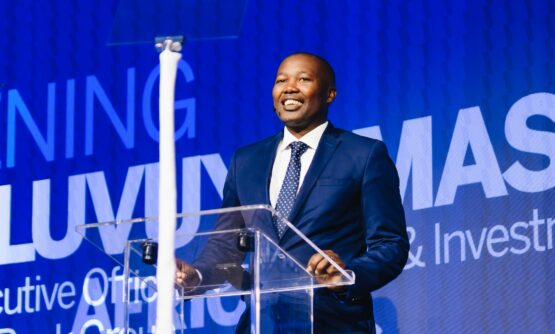
Luvuyo Masinda, chief executive of Standard Bank Corporate and Investment Banking, said during a question-and-answer session on the sidelines of the conference that currency shifts ultimately follow trade flows.
He acknowledges growing interest in renminbi usage, noting that Standard Bank already facilitates both dollar payments and transactions through China’s Cross-Border Interbank Payment System (CIPS), positioning the bank to support whichever channels clients choose.
Kenya’s experience – where shifting some borrowing into renminbi lowered costs – has prompted increasing inquiries from other countries.
Masinda says there is about $4 trillion (around R64 trillion) of investable capital available for Africa. The main constraint is not a lack of funds – it is the shortage of bankable projects.
Although vast pools of capital exist globally, governance gaps, regulatory uncertainty and inconsistent transparency continue to deter large-scale investment on the continent.
Be cautious of more debt
Africa’s debt dynamics also require urgent reform, he says.
“While sovereign debt levels are not unusually high by global standards, the cost of servicing that debt relative to governments’ ability to collect revenue is still too high.”
Masinda warns African sovereigns against accumulating additional debt unless it finances productivity-enhancing infrastructure.
Ban Ki-moon’s rebuke
In an afternoon session, former UN Secretary-General Ban Ki-moon – a keynote speaker – delivered a sharp critique of former US president Donald Trump’s policies.
He warns that unpredictable leadership and withdrawals from multilateral institutions, including the World Health Organisation and international climate agreements, are undermining global cooperation.
Ban expresses particular anger over the abandonment of climate commitments he had helped negotiate, arguing that climate change poses a universal threat regardless of geography.
He urges African nations to continue pursuing mitigation and adaptation efforts aligned with the Paris Agreement, even as major powers waver.
He also calls for stronger democratic governance across Africa amid what he described as a global trend of “democratic backsliding”.
Civil society, business leaders, and the private sector, he says, must play a role in defending democratic institutions.